Photographing a Private Cycling Tour in Tuscany
From Road to Book, a Story Built in Motion
In brief: six days of riding in Tuscany in June 2026, photographed mostly from the back of a motorbike, then carried through to a printed photo book, a private online gallery and a Director’s Cut film.
A private corporate cycling tour in Tuscany might sound like a straightforward photography brief: follow the riders, document the days, deliver the pictures. In practice, it was a much more layered commission.
This was not simply event coverage. It was a complete sports and lifestyle storytelling project, photographed across multiple days on the road and then shaped into three finished pieces: a printed photo book, a private online gallery and a short Director’s Cut film.
That changes the way you work from the beginning. You are not only thinking about individual photographs. You are thinking about sequence, rhythm, atmosphere, print, privacy, movement and memory. The images need to carry the physical experience of the ride, the character of the place and the feeling of the group, while still being strong enough to hold together as a finished body of work.
The physical side of the commission was demanding: long days in serious heat, moving with riders across Tuscan roads, working from the back of a motorbike and making fast decisions as the light, route and group dynamics kept changing. But the real task was bigger than the ride itself. The work had to travel from road to printed page, from gallery to film, and still feel like one coherent story.
This is how the project came together, for anyone considering a cycling tour photographer, a corporate sports photography commission, or a private sports and lifestyle project with a finished book, gallery or film at the end of it.
Understanding the brief
The brief was to photograph a private corporate cycling tour with a multi day story to tell. It was not only about documenting the riding. The final work needed to become a printed book, a private online gallery and a short Director’s Cut film, so the photography had to hold together across several different forms.
Discretion mattered. The project was private, so the images had to respect the people involved as much as they documented the experience. Consistency matters too, because a book quickly shows up any weakness in tone, rhythm or finish from one page to the next. The final result had to feel considered, polished and in keeping with the quality of the tour itself.
That meant thinking beyond coverage from the beginning. A set of event photographs can be useful, but a complete visual story needs shape. It needs a beginning, a rhythm and an ending. It needs enough variety to carry the viewer through the days, and enough restraint to make the final selection feel coherent.
For me, that is where a project like this becomes interesting. The job is not just to make strong images. It is to understand what the client needs the work to become, then photograph with that end point in mind.
Preparing for a moving sports story
Photographing a cycling tour means photographing a story that will not wait for you. Riders move at different speeds. Groups split, regroup, stop, climb, descend and disappear around corners. The best photograph might happen on a stretch of road you cannot return to, so preparation is key.
Before a project like this, I think as much about the story as the logistics. I need to understand the route, the likely stops, the rhythm of the day and where the light might work. I am looking for places where the riders can sit properly within the landscape, rather than simply being photographed on top of it. Tuscany is visually generous, but the strongest images still depend on position, timing and restraint.
The kit decisions are practical too. I need enough flexibility to move between action, landscape, details and subtle human moments, but I also need to work safely and quickly. On a moving cycling tour, anything carried has to earn its place. Anything left behind may not be reachable when the moment happens.
Weather is another variable. The tour turned out dry and hot, with temperatures in the thirties and reaching 38 degrees, but I still had to prepare for conditions we never saw. From the back of a motorbike, there is no easy way to go back for the thing you decided not to carry. I would rather carry the weight of a plan I do not use than stand at the side of a Tuscan road with the wrong kit.
That preparation is what allows the photography to feel fluid later. The more clearly the practical structure is understood, the more freedom there is to respond instinctively when the story starts to unfold.
Photographing from the road
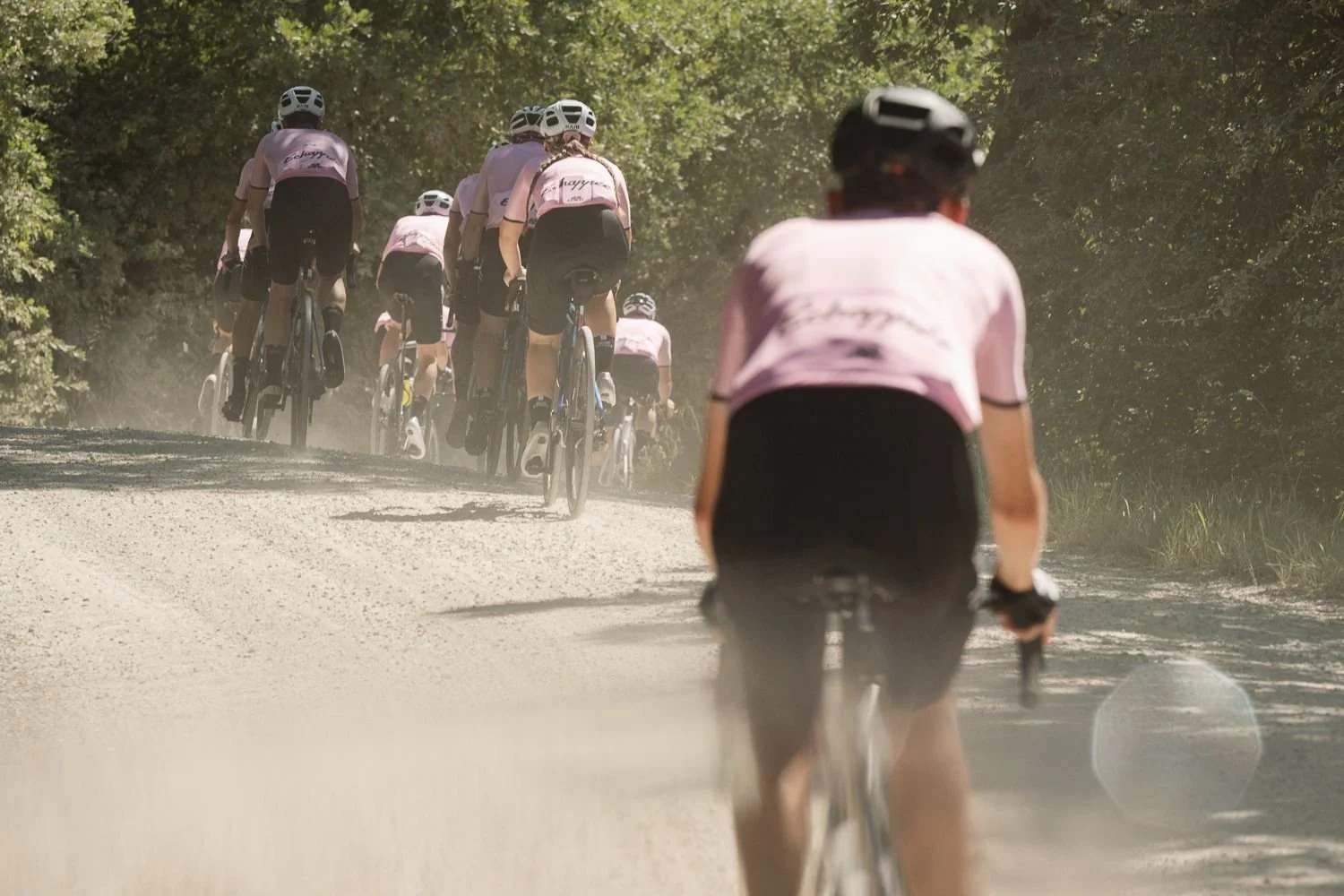
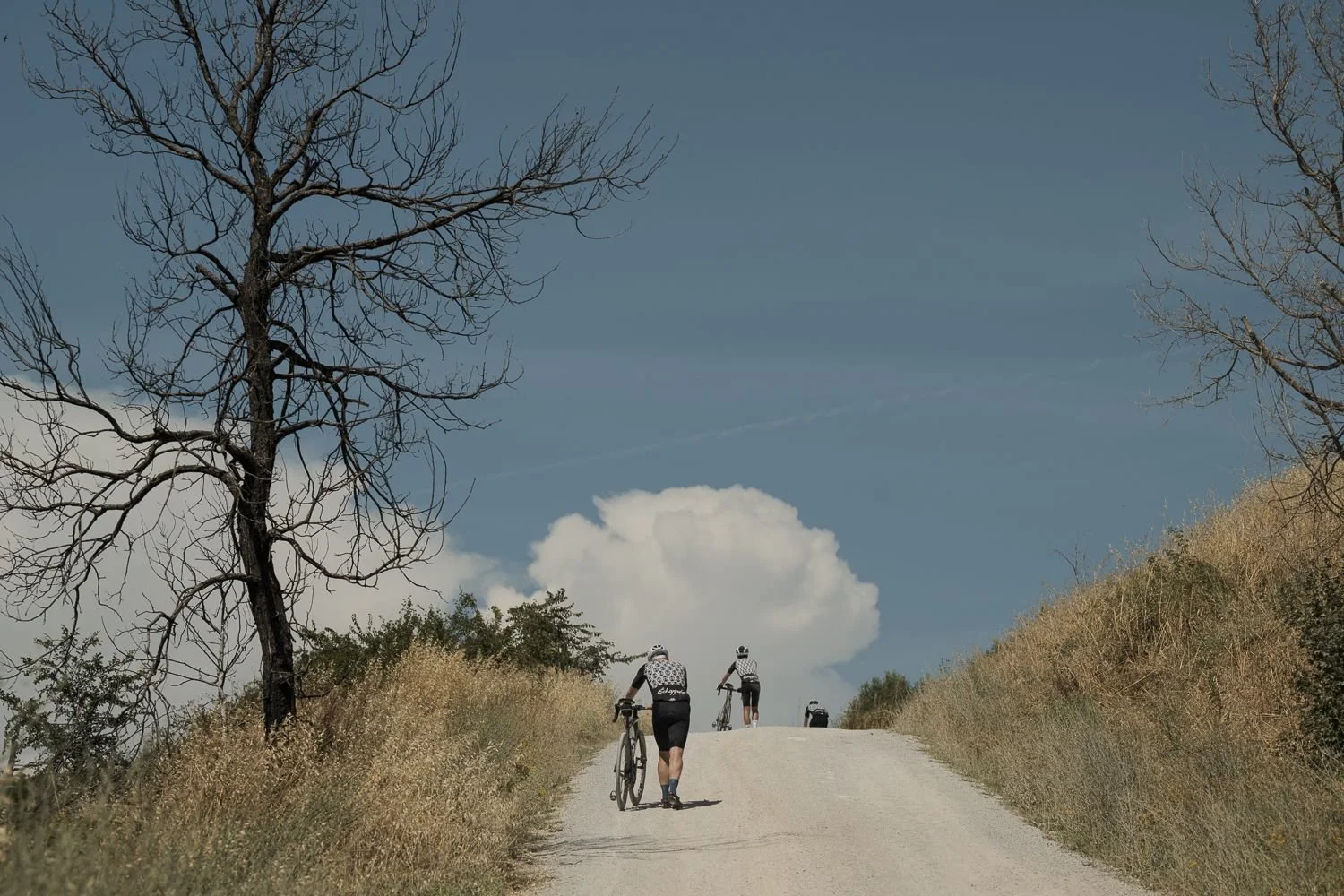
The first thing you feel on the Strade Bianche is the vibration. The white gravel roads are beautiful, but from the back of a motorbike they are also dust, heat, noise and movement. You are trying to hold a frame while the bike shifts underneath you, the riders move around you, and the landscape changes faster than you can fully process it.
Much of the riding was photographed from the back of a motorbike, working with an experienced rider who understood the road, the cyclists and the position I needed to be in. That trust matters. When you are pillion on gravel with your attention partly on a viewfinder, you need the person in front to read the surface, the group and the movement around you.
The roads were hard on the equipment as well as the body. Dust worked its way into everything, and the vibration loosened filters on my lenses. Checking kit became part of the rhythm of the day. It is not a controlled environment, and that is part of what gives the pictures their energy, but it also means you have to stay alert to the small practical things that can ruin a frame.
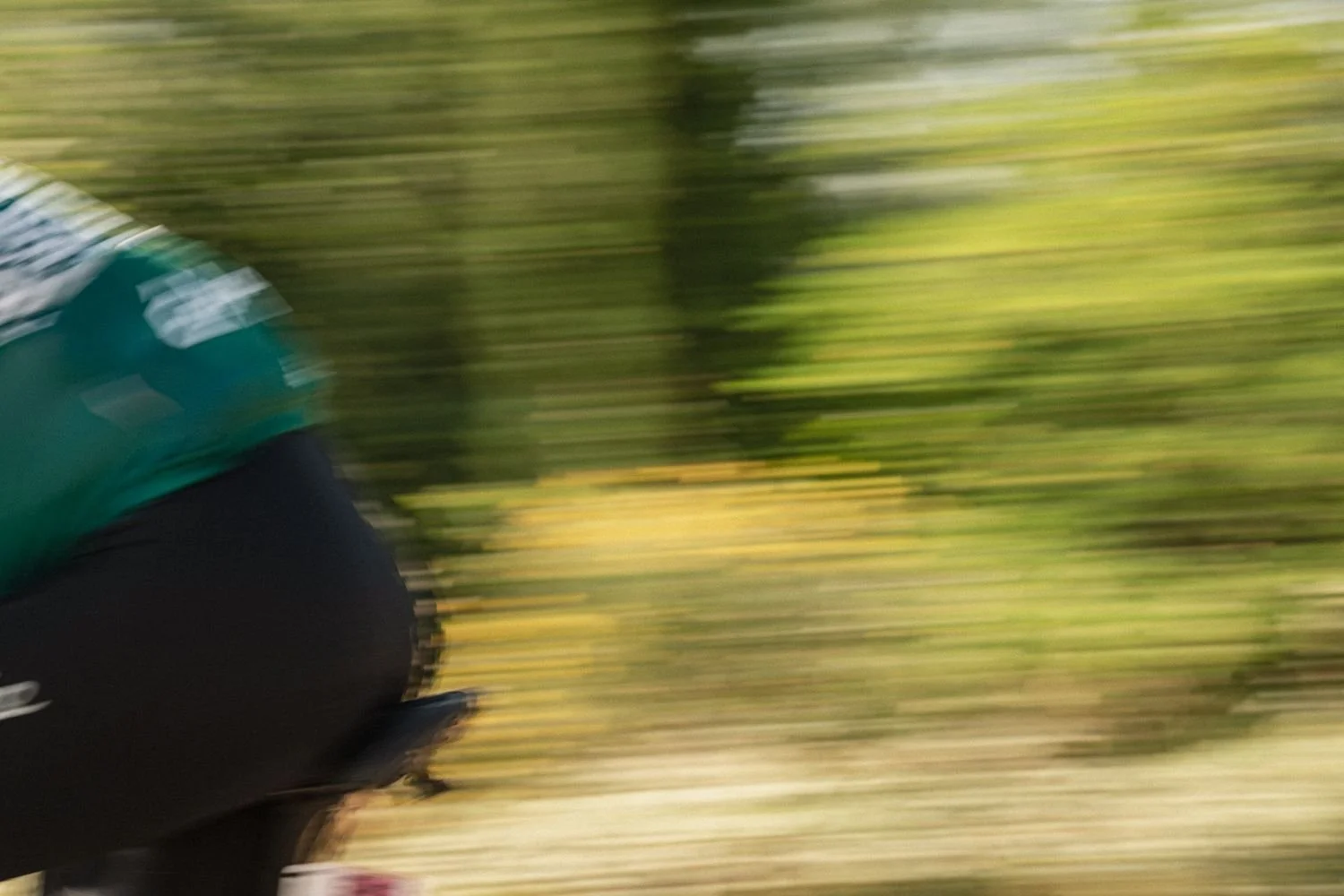
It also changes how you think about motion. Still photographs can use the speed and vibration of the road in one way. Moving footage needs another kind of judgement, because you cannot rely on fixing everything later. You choose moments where movement adds atmosphere rather than distraction.
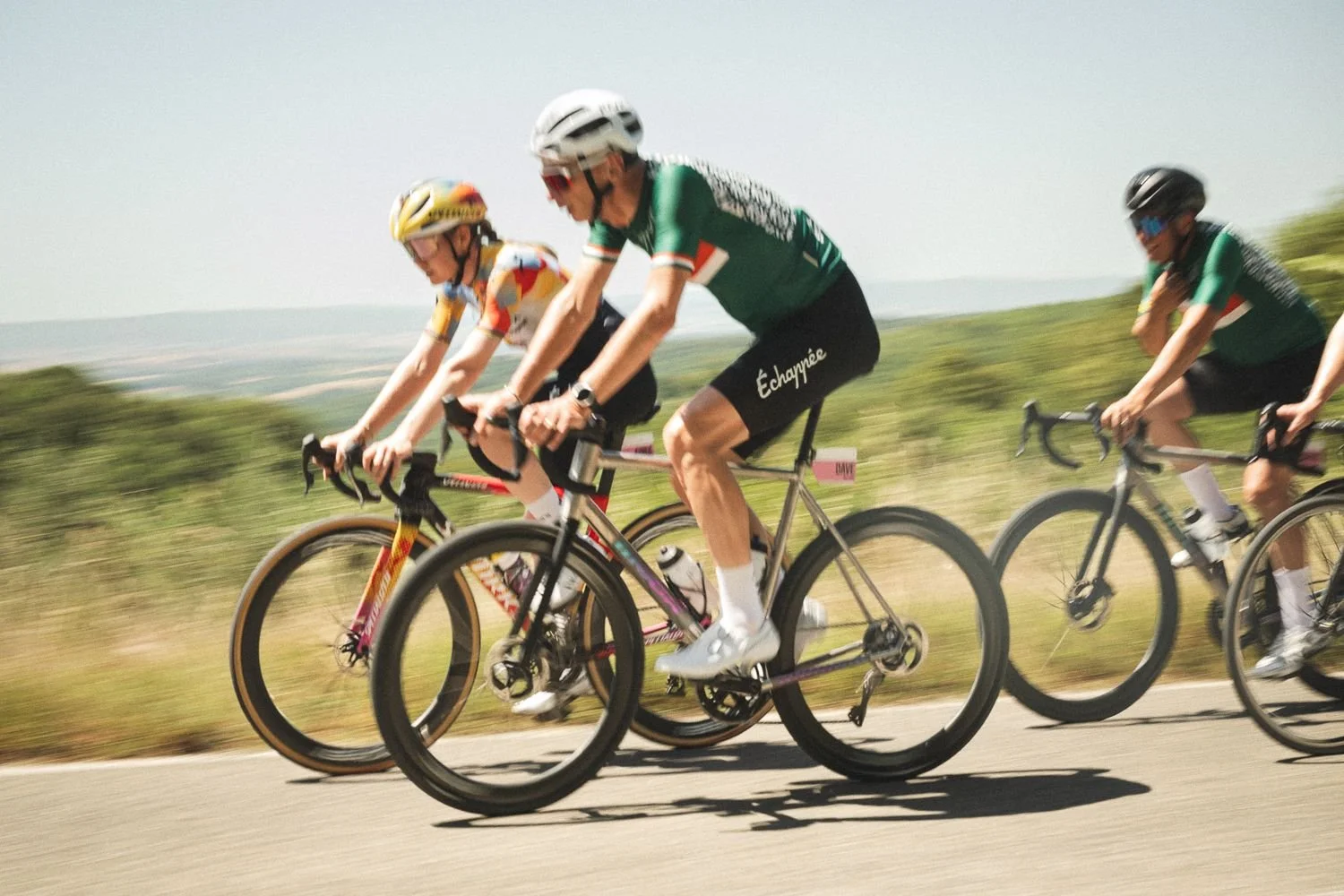
The physical position is demanding too. To make strong road cycling photographs from a motorbike, you are often turned sideways, balancing, bracing, twisting and holding a frame while the bike moves over uneven ground. It is not glamorous in the moment, but it gives access to images that would be impossible from a fixed roadside position.
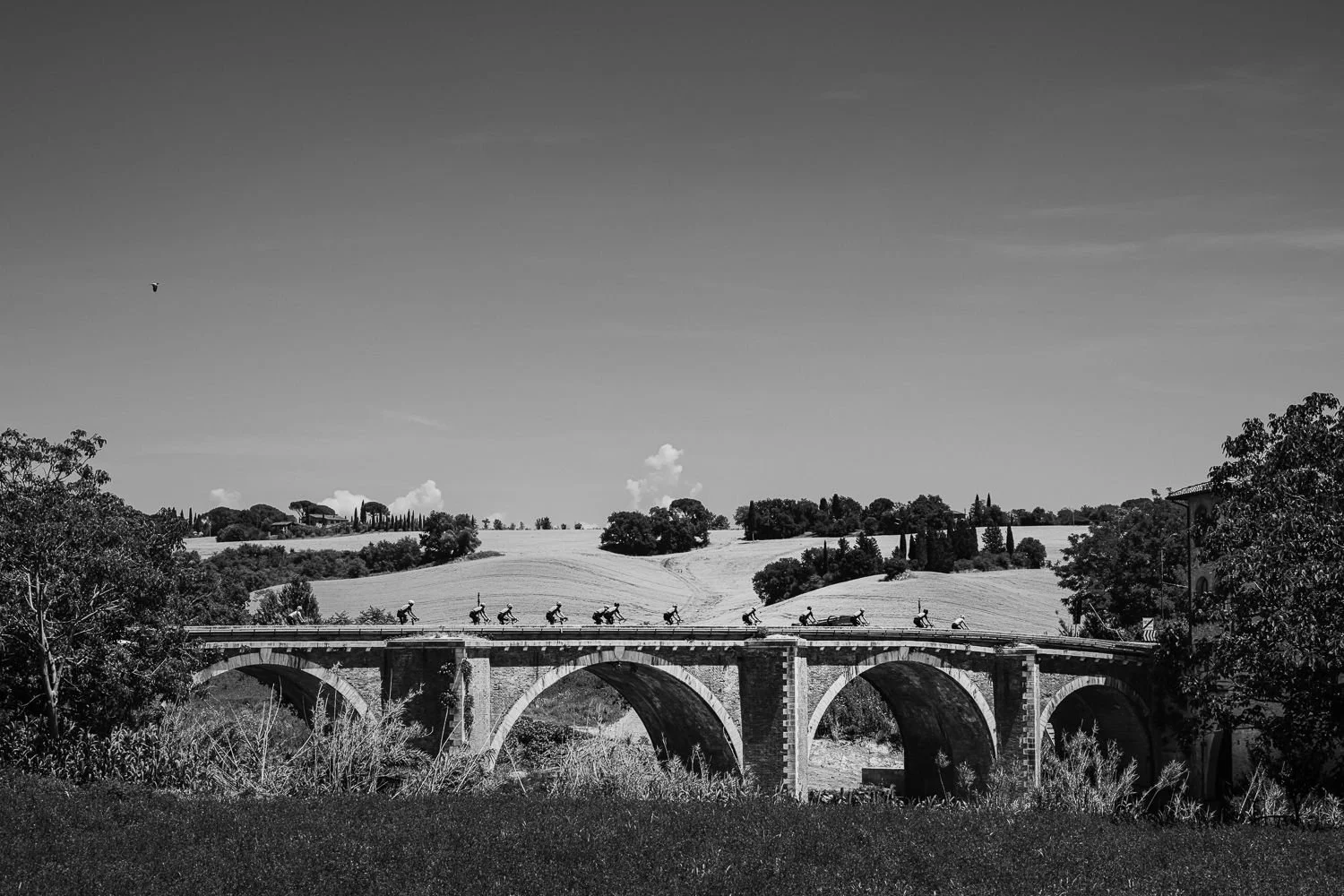
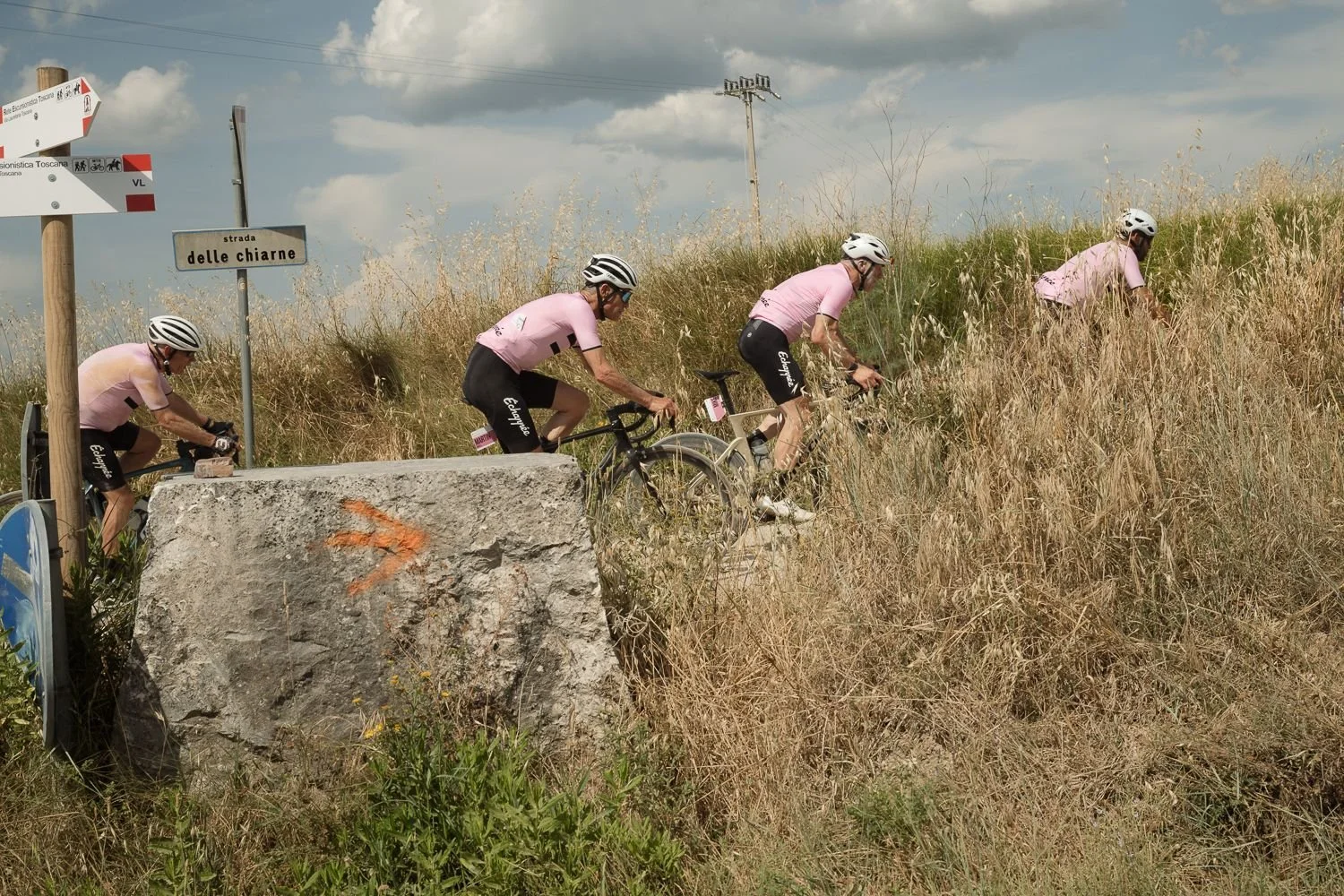
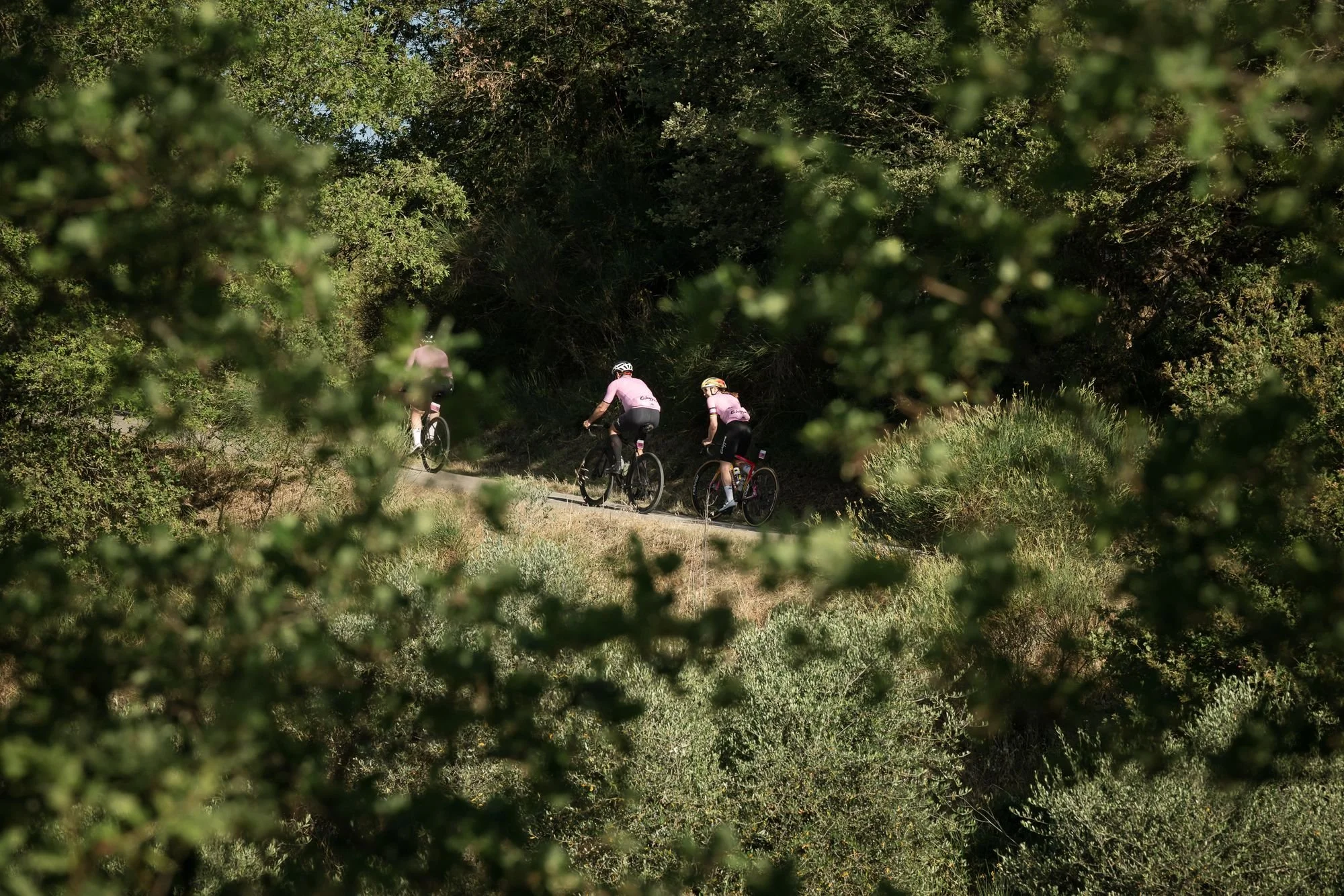
Some of the best photographs, though, came from getting off the bike. On foot, I could frame riders through foliage, use the shape of the road, let the landscape breathe and place the viewer inside the scene rather than just looking at it. If a group had gone ahead, I would often stay roadside, because the story is not only at the front.
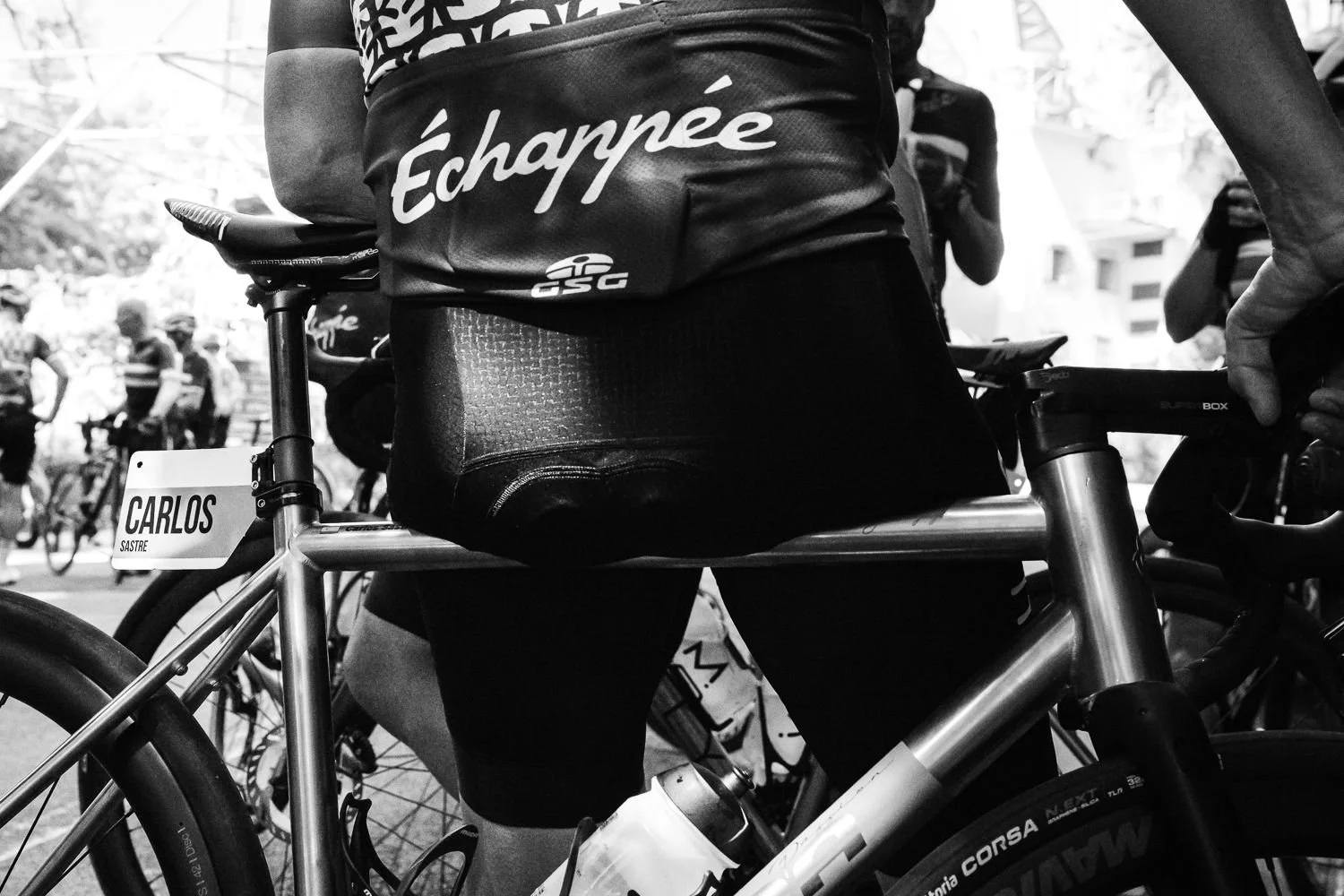
That is where documentary cycling photography becomes more than action. It is noticing who is still to come, who is looking after whom, where the support team is working, and where the more subtle moment might be. Landscapes, riders, staff, details and atmosphere all mattered, and they all had to be photographed with the same eye so the final body of work would belong together.
Building a visual narrative
Six days on the road produces a lot of pictures. The skill is not only in making strong individual frames, but in understanding which images earn their place in the wider story.
With cycling, repetition is always a risk. Riders on a road can start to look similar if the selection is built only around action. So I was looking for rhythm: a wide Tuscan landscape that gives the viewer space, then a tighter frame of effort, then a smaller human moment that brings the story back to the people inside it.
The conditions gave the photographs a physical honesty. The heat, the gravel, the long climbs and the terrain were all part of the story. You could see the effort in the riders’ bodies, in the dust, in the way people recovered at the side of the road, and in the rituals that repeated across the days.
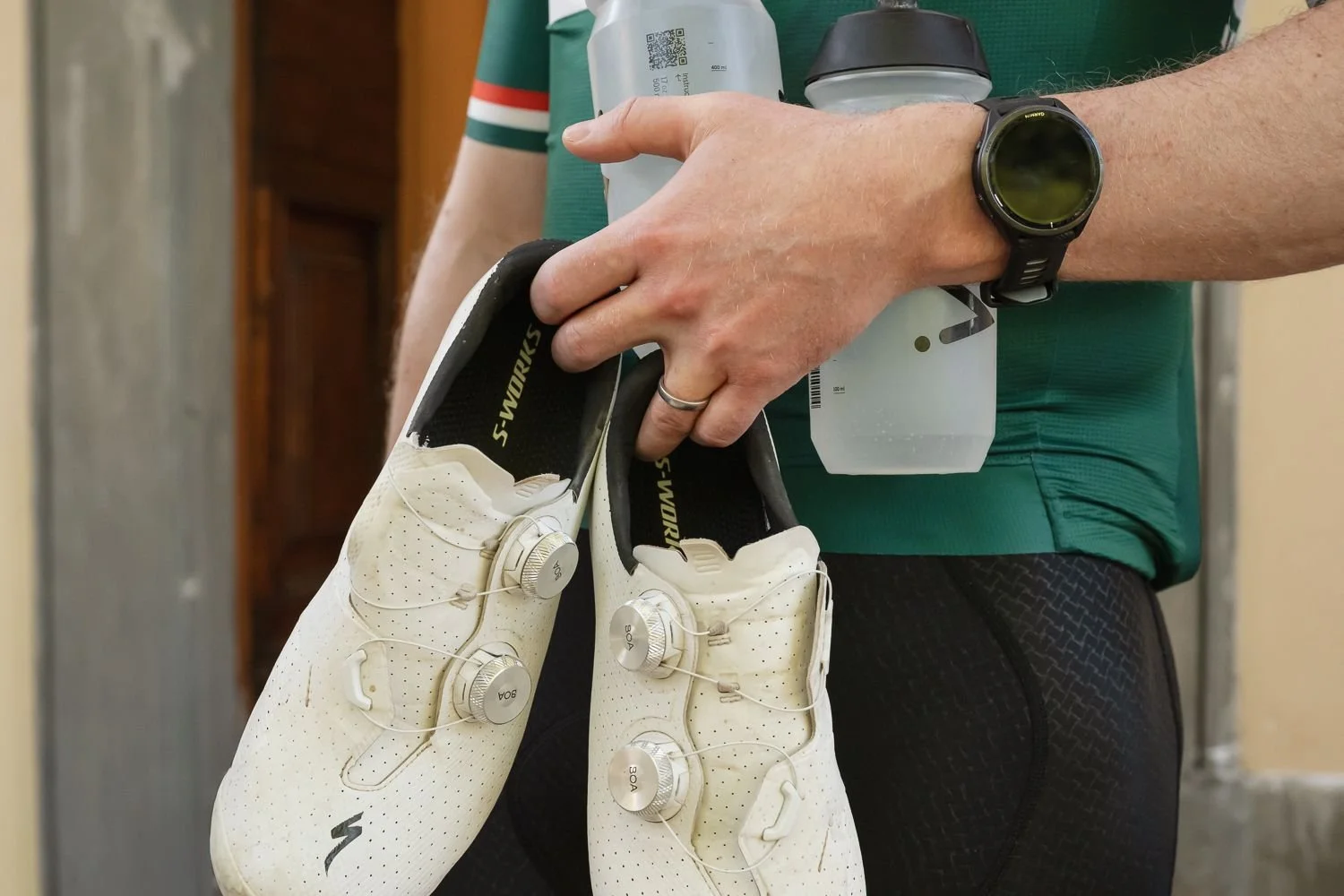
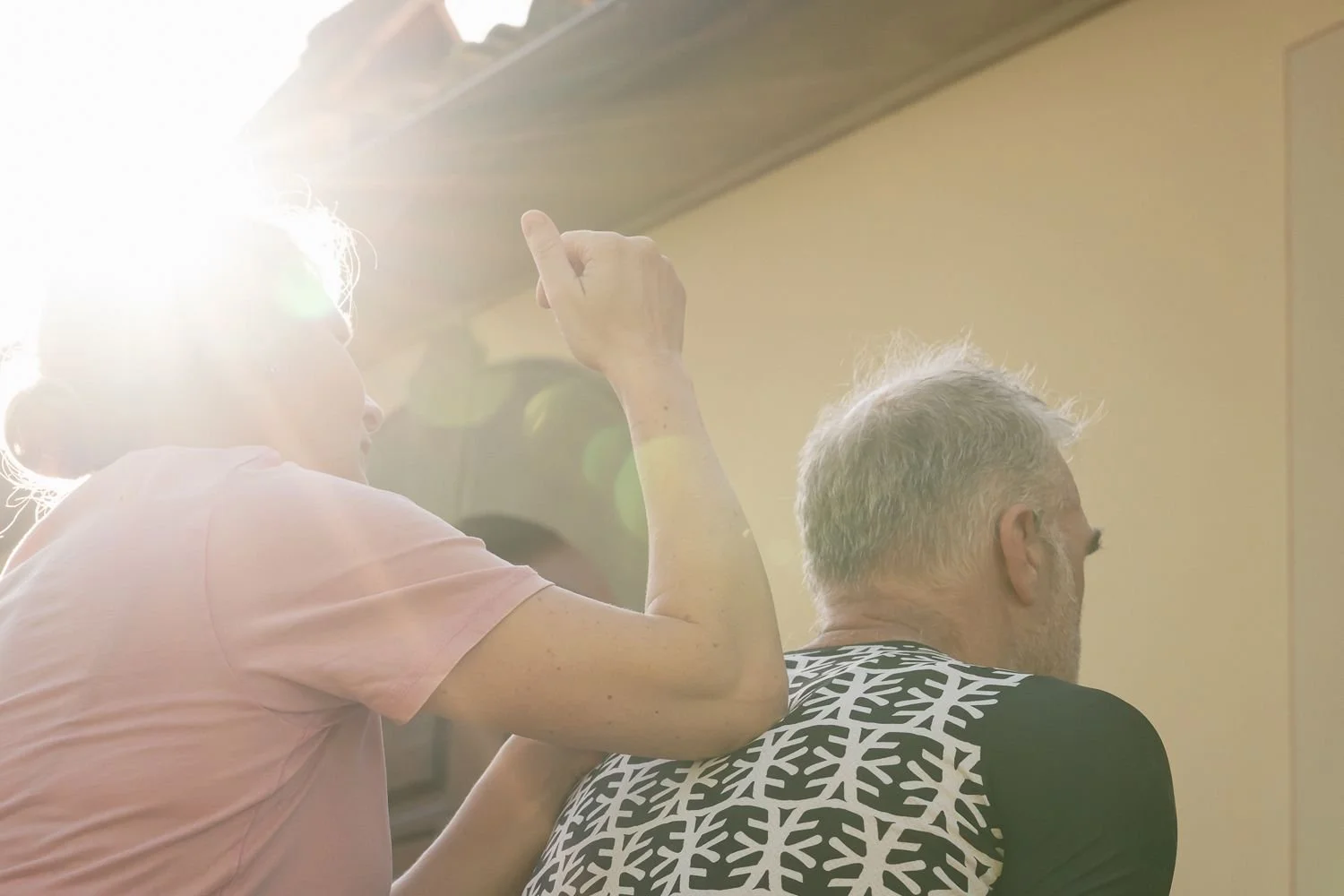
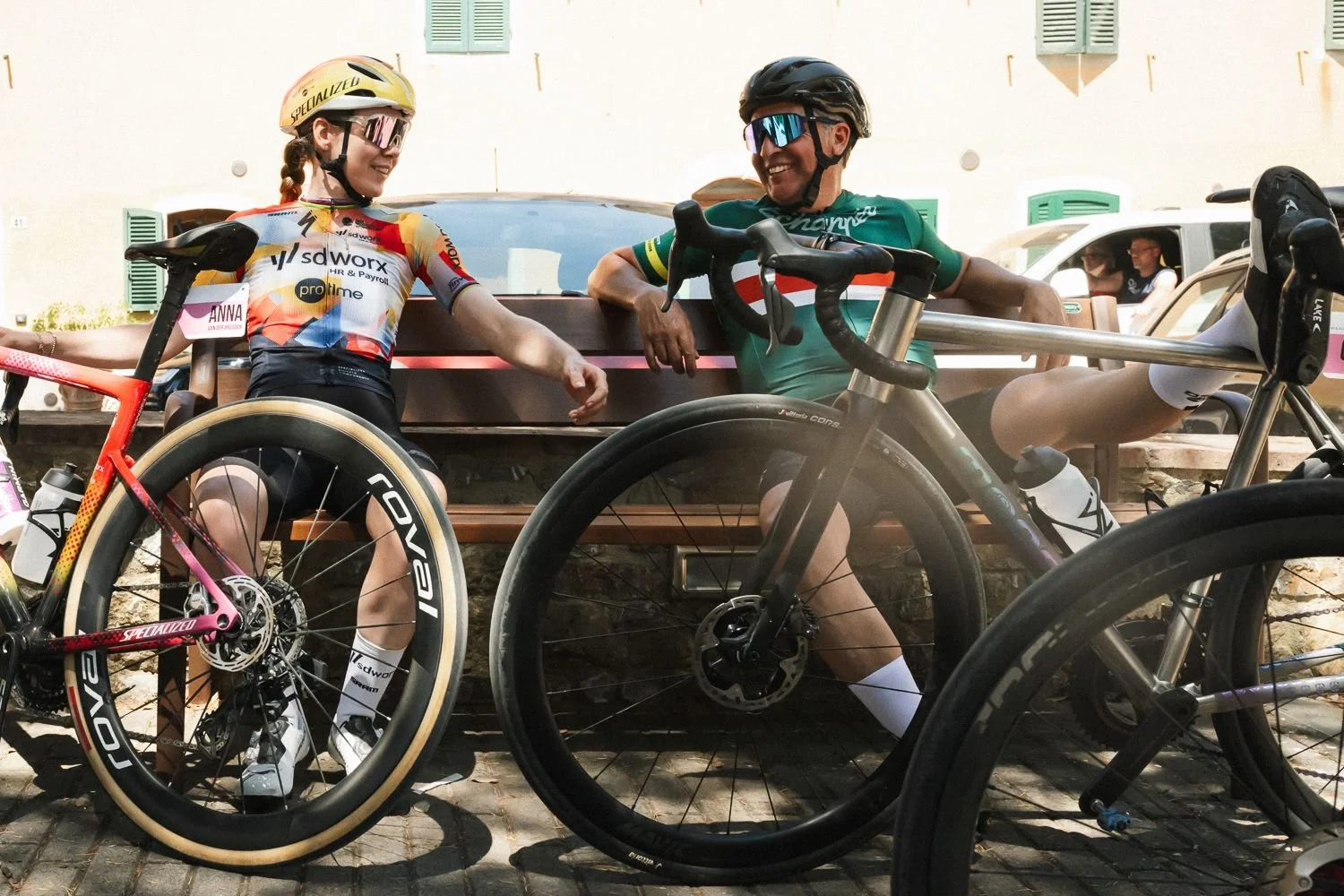
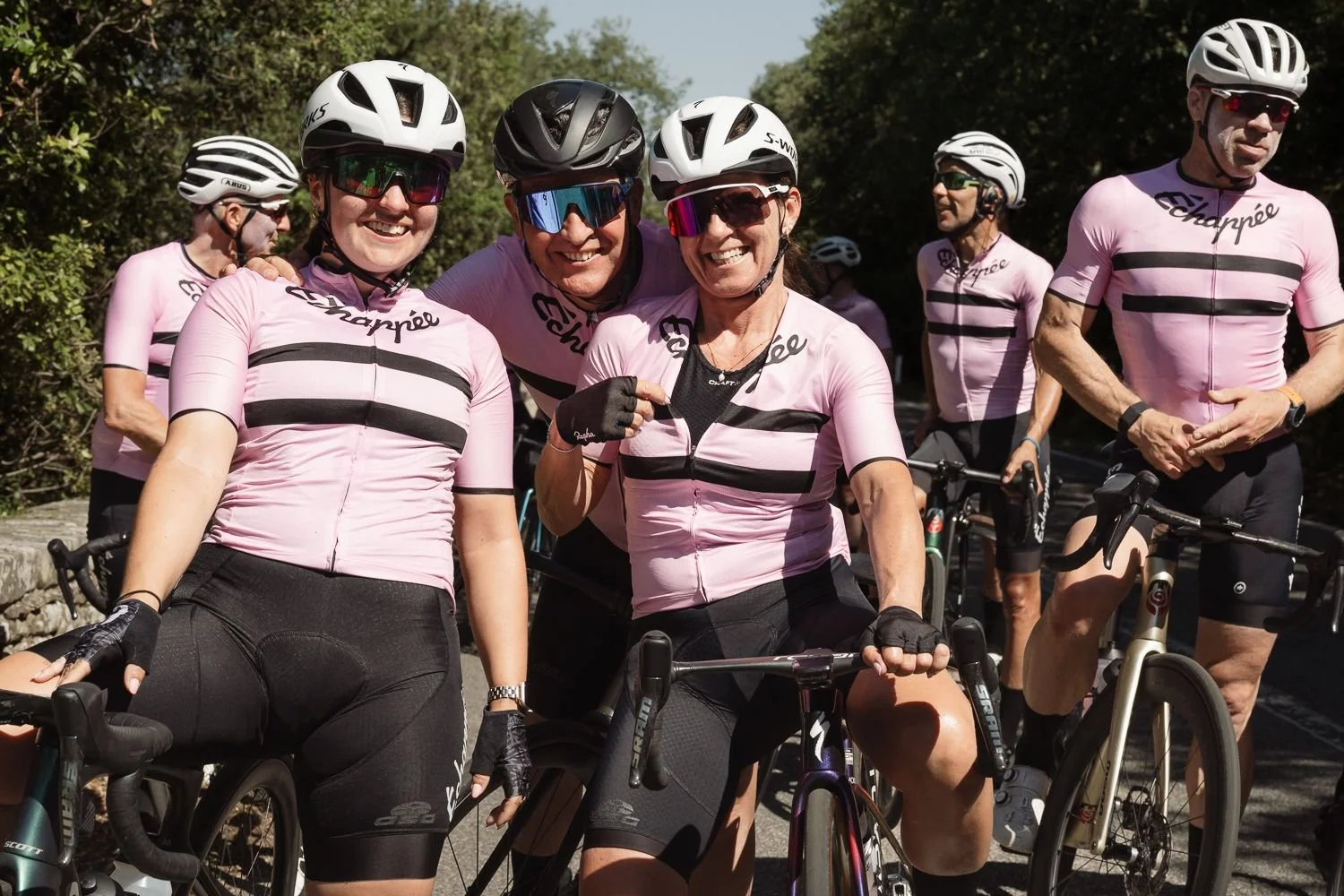
Some of the most important pictures came at the rehydration stops. That is often where a group stops feeling like separate riders and starts to read as a team. Someone checks in. Someone hands over a bottle. People laugh, regroup, cool down, or stand together in the shade before the road begins again.
A good sequence needs both. The hero images give the story its scale and the subtle moments give it meaning.
From cycling photography selection to a printed photo book
Once the riding was over, the work changed character. I culled 30,000 frames down to around 3,000 contenders for the story. From there, the project moved from coverage into construction: which images had strength on their own, which ones helped the sequence breathe, and which ones gave the book its rhythm.
A printed book asks different questions from a gallery. It is not enough to place the strongest pictures one after another. A book depends on flow, scale, pacing, colour, negative space and the way one image changes the feeling of the next. The selection becomes a process of judgement, not just preference.
The layout was shaped in collaboration with Sarah, whose visual sense brought another layer to the project. We developed a shared visual workflow so ideas around crop, tone, sequence and treatment could be explored in context. That was important, because collaboration on a printed project is partly creative and partly practical. The stronger the visual language becomes, the easier it is to make decisions without losing the thread of the story.
There is always a negotiation in work like this. A design idea might ask more of a photograph than I would naturally choose. A crop might be more ambitious. A treatment might push the file in a different direction. Those decisions can work beautifully, but they need to be made consciously because they affect resolution, grain, texture and sometimes the meaning of the image itself.
I graded and finished the images with print in mind. Colour, tone, crop, grain and sharpening were all decided for the page, not the screen. A print has a different appetite from a monitor: shadows close, skin tones shift, and sharpening that looks right digitally can look too hard on paper. In a book, no picture is seen alone, so every image has to work both as a photograph and as part of the sequence around it.
What this stage reinforced for me is that creative ambition needs a clear production structure. The best results come when everyone understands what belongs to photography, what belongs to design, and where the two meet. That clarity is not restrictive. It is what allows a complex project to keep moving, protect the integrity of the images, and still arrive as a coherent finished book.
The private online gallery and Director’s Cut film
The private online gallery and Director’s Cut film gave the story a different kind of shape. A printed book is slow and tactile. It asks the viewer to move through the work page by page. A gallery is more open. It gives people space to browse, return, recognise themselves and find the moments they recall. A film is more compressed. It has to carry feeling quickly, through sequence, movement, music and pace.
This was the point where I could bring the work back into a purely photographic selection and sequence. The Director’s Cut was not a chronological recap of the tour. It was my interpretation of the journey, shaped through image order, rhythm, atmosphere and the relationship between stills and motion.
I wanted the sequence to ebb and flow in the way I remembered the trip: the road, the heat, the dust, the climbs, the pauses, the landscape opening up, and the human details between the bigger riding moments. It was important that the images were finished exactly as I intended them, with the colour, tone, crop and pacing working together as one clean photographic story.
The film brought the stills and moving footage together in a more immediate way. Some moments needed motion, because the energy of the road, the vibration of the bike and the rhythm of the riders carried something that a still image could not. Other moments were stronger as photographs, because they held the feeling still for longer.
The gallery and Director’s Cut allowed the project to breathe beyond the book. They gave the client a private digital space for the wider story, while the film offered a more personal, concentrated version of the experience. Together, the three outputs did different jobs: the book gave the project weight, the gallery gave it breadth, and the Director’s Cut gave it my photographic rhythm.
What clients should know about this kind of commission
A project like this takes more time than most people expect. The visible part is the photography on the road, but the value is also in the preparation, the culling, the sequencing, the image finishing, the print proofing, the gallery structure and the film. If the final delivery includes a book, a private online gallery and a Director’s Cut film, those outputs need to be planned from the beginning.
Standard event photography is usually judged on coverage: did we get the key moments? A complete sports storytelling project is judged differently. It has to hold together. The photographs need to work individually, but they also need to sit beside each other, support a sequence and carry the feeling of the experience across different formats.
That is why the planning stage is essential. The book affects what needs to be photographed. The gallery affects how much breadth is needed. The film affects how I think about movement, atmosphere and pace. Deciding on these outputs after the event can mean discovering that the project needed different kinds of images, more time, or a different production structure.
For clients commissioning this kind of work, I would always suggest being clear from the start about the final outputs, the number of finished images, who is responsible for layout, who is in the decision loop, and how changes will be handled. Late opinions are one of the most common causes of delay and rework, especially once a book is already in layout or proof.
It is also worth understanding that photographic finishing for print is not the same as delivering a screen gallery. Print takes longer. Colour, tone, crop, resolution, grain, sharpening and paper all matter. A printed book is a beautiful final object, but it asks for care at every stage.
That time is not a problem when it is understood and planned properly. It is part of the investment. A project like this is not just buying coverage of an event. It is commissioning a complete visual record, built carefully enough to become something lasting. If you would like more on how I scope projects, I have written a practical guide to commissioning a photographer.
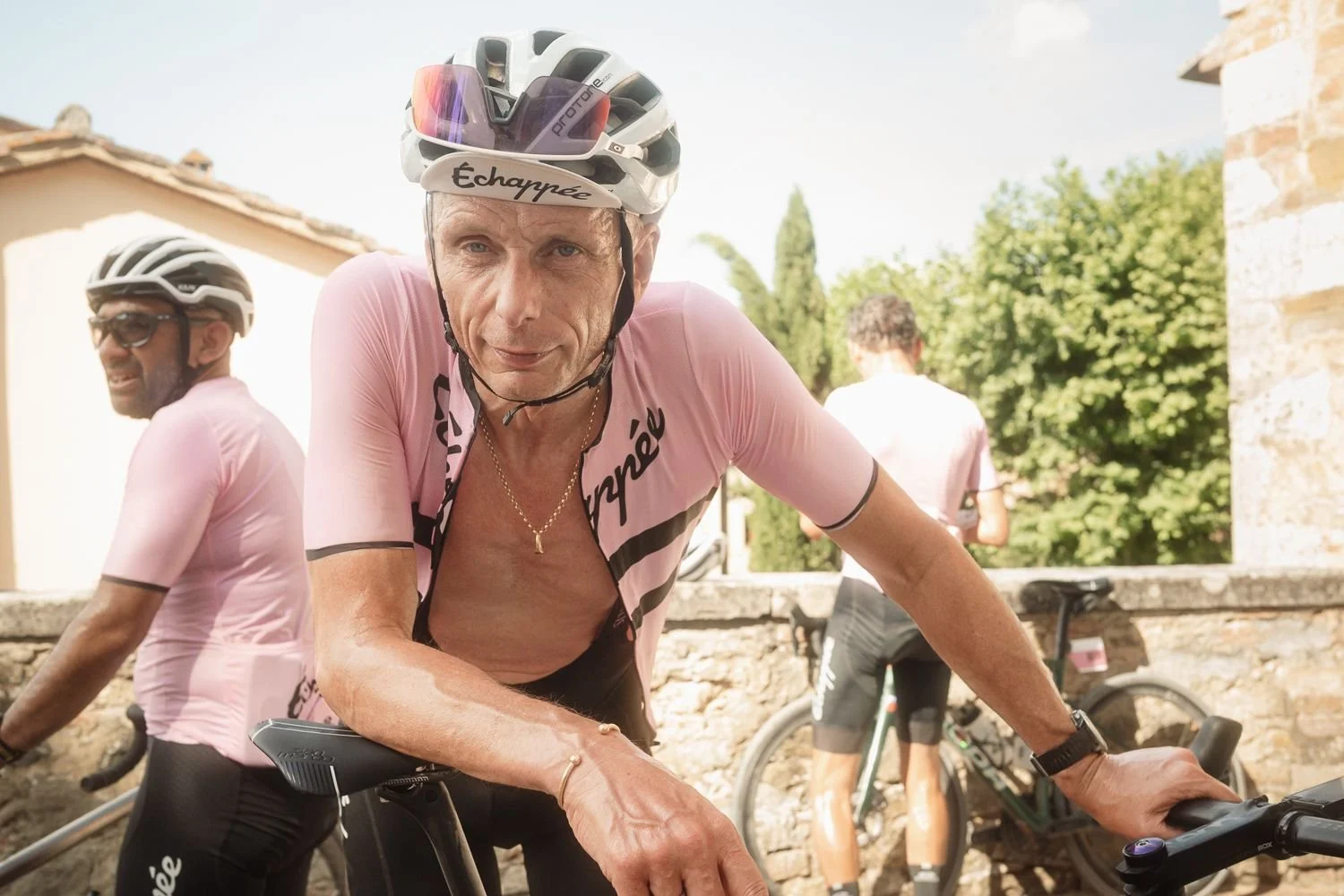
From Road to Printed Book: A Complete Sports Photography Production
What I enjoyed most about this project was that it was never just one person’s work. A commission like this depends on trust, communication and a team that understands the value of the final story.
Mark at Echappée trusted me with the direction of the photography and gave me the freedom to work in my own way. He also brought a deep knowledge of the route, the riding and the places that had the potential to deliver something special. That mattered. On a project where the strongest images are not always the most obvious ones, that combination of trust and local route knowledge helped me find moments I would not necessarily have anticipated alone. Sometimes the story is in the ride, sometimes it is in the landscape, and sometimes it is in a moment between people that only works if you have been given the space, and the right opportunity, to notice it.
Sarah’s curation and eye for composition shaped the book into something beautifully considered. Seeing the work in print made me appreciate how much the flow of the book depended on those choices: the pacing, the scale of the images, the use of space, and the way one spread led into the next. A good printed book is not simply a collection of strong photographs. It is a sequence, and that sequence needs care.
On the road, Gery was central to what I could make from the back of the motorbike. Photographing cyclists from a pillion seat only works if there is complete trust between photographer and rider. He read the road, the riders and the space around us, which allowed me to concentrate on the frame. A lot of the energy in the riding images came from that working relationship.
The wider support team mattered too. Everyone on the ground worked incredibly hard, often in serious heat, and there was a real sense of people mucking in wherever they were needed. Moving kit, supporting riders, managing stops, keeping the day flowing and making sure people were comfortable all sat behind the finished work. It may not be obvious on the printed page, but it is present in the feeling of the book.
That is what made the final production satisfying. The photography began on the road, but the finished project became much more than road coverage. It became a printed book, a private gallery and a Director’s Cut film, each carrying the story in a different way.
For me, this is the kind of commission I value most: physically demanding, visually rich and built through trust. I am grateful to Mark at Echappée, Sarah, Gery and the wider team for that trust, and for the collaboration that allowed the project to become what it did.
I am a London based sports and lifestyle photographer, and I work with private clients, corporate teams and creative producers who need a project carried from the road to the final printed page. You can see the full set of rider support pictures in the Echappée cycling tour portfolio, more brand work in my Nike x Rebel Girls tour photography, and the full range in my commercial photography commissions. If you are planning a private corporate tour or a similar sports storytelling commission, I would be glad to talk.
Quick answers
What does a corporate cycling tour photographer do?
A corporate cycling tour photographer photographs the riders, staff, landscapes and atmosphere across the tour, then shapes the best of it into a finished story. On this project that meant moving with groups across six days of riding and carrying the pictures through to a book, a private gallery and a film.
How is it different from standard event photography?
Standard coverage is judged on whether the key moments were captured. A cycling tour moves, takes place over several days and ends in finished work, so it needs preparation, physical stamina, careful sequencing and print finishing.
Can photographs from a private tour become a printed book?
Yes, and it is best planned from the start. The book affects what is shot, how images are cropped and how much time is allowed for finishing and proofing.
How do you photograph cyclists from a motorbike?
Pillion, with a rider you trust completely, and with kit that survives vibration. It means holding awkward angles for long stretches and getting off the bike when the story moves elsewhere.
What should I decide before commissioning a project like this?
The final outputs (book, gallery, film), the number of finished images, who handles layout, who makes the decisions, and the time needed for print.